
Whole class discussion is the part of the Algebra Project Work Cycle where everything comes together. After students have wrestled with ideas individually, and after they’ve built meaning with peers in small or one-on-one groups, the conversation opens up to the room as a whole. In theory, it sounds simple: students share their thinking, the teacher guides them, and understanding deepens. In practice, it’s one of the most complex and artful moves in teaching.
Few people know this better than Dr. Cathy O’Connor, longtime professor at Boston University’s Wheelock College of Education. Her career has been shaped by studying how teachers orchestrate talk in classrooms not just to deliver information, but to build students’ sense of themselves as thinkers. That work took on new depth when, in 1990, she was introduced to Bob Moses and the Algebra Project.
At the time, Cathy was looking for teachers who excelled at discussion. They were rare then, and, she notes, they remain rare today. Bob sent her to observe a middle school math teacher at King Open School in Cambridge, Massachusetts: Lynne Godfrey. What she found in Lynne’s classroom would become foundational to her decades of research.
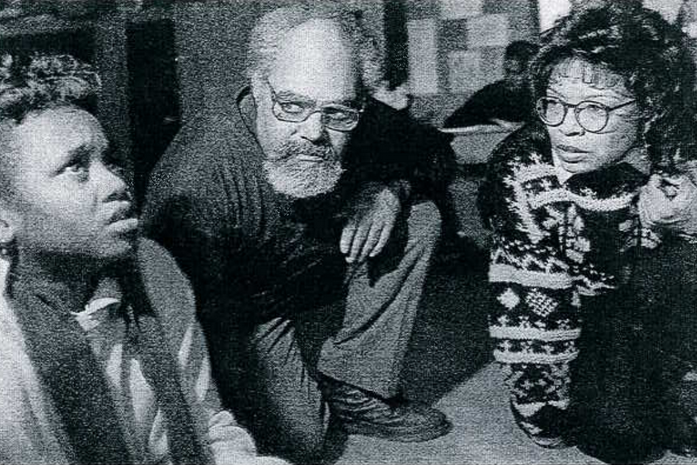
“I had never seen a teacher use talk so skillfully,” Cathy recalls. “From the first day, she got students to think about the problem, put into words what they were thinking with a partner, and then share with the whole group. The challenge, though, was what she did next—how she worked with what they said, getting them to move together to the next step, thinking more deeply. And how she continued to provide space for them to think together in spite of their social differences. Lynne is a genius at this.”
Step Three doesn’t happen in isolation. Its strength depends on what came before. Students first need quiet time to think on their own—Step One. Then they need the chance to test and stretch their ideas with a peer—Step Two. By the time the teacher opens the floor, Cathy explains, “you can expect that every student has had at least some preparation for the group talk. And facilitating the group talk is not easy, so you want to be sure that every student has some ground to stand on, to the greatest extent possible.”
This scaffolding matters because whole class discussion is where the stakes feel highest. The room is no longer small and private; it’s public. Social hierarchies, cultural differences, and uneven confidence levels all show up. Cambridge in the early ’90s was an especially complex landscape, with children of Harvard professors sitting alongside recent immigrants and working-class kids from across the city. For discussion to work equitably, no one could be left behind.
That’s where Lynne’s skill, and the broader vision of the Algebra Project, shined. Rather than treating students’ differences as barriers, she used discussion to bridge them. In doing so, she modeled what the Work Cycle is designed to do: make mathematics a shared, living language.
If small group collaboration is like a jazz ensemble, whole class discussion is a symphony. The teacher doesn’t play the instruments but conducts, shaping how voices enter and connect. That requires both strategy and improvisation.
This invisible labor of equity ensures that the conversation continues to move forward while also protecting students’ right to belong in it.
“The teacher’s job in facilitating discussion,” Cathy emphasizes, “is keeping both contingents engaged and focused: the students who already understand the topic, and the ones who don’t. That’s very difficult.” Add in the pressure of the clock, with administrators expecting curriculum coverage, and it’s no surprise that many classrooms default to lecture instead of discussion.

But when it’s done well, the results are transformative. Cathy recalls a later project in Chelsea, Massachusetts, where most students were multilingual learners from low-income families. Teachers there adopted consistent discussion practices informed by what she had learned from Lynne. After a year, students performed in the 90th percentile on a national standardized math test. “Consistent discussion can make a difference in performance,” Cathy says. “But more importantly, it changes how students view themselves.”
That shift in identity, seeing oneself as capable of reasoning aloud, of contributing to a collective inquiry, is at the heart of why Step Three matters.
“I have seen that skillful and committed facilitation of discussion can change how students view their own capacities,” Cathy reflects. “It can change how they view themselves. And then it changes how they view the task of school-based learning. This is a key part of equity.”
For the Algebra Project, math literacy was never just about numbers. It’s about enfranchisement. It’s about giving young people the tools to navigate and shape a world structured by quantitative reasoning. Whole class discussion embodies this mission because it is both intellectual and democratic. It asks students to practice listening to one another, weighing ideas, and articulating their thinking in community.
The learning that emerges isn’t always tidy. Discussions meander. Students put forward half-formed thoughts. Wrong answers are aired. For some administrators, this looks like wasted time or even chaos. But in truth, it’s how deep understanding develops. As Cathy puts it, “Many administrators—and some teachers—still think discussing student understandings that are ‘wrong’ is a waste of time. It’s hard to overstate how much we’ve internalized the idea that math is about getting the right answer as straightforwardly as possible. But in fact, talking through misunderstandings is central to learning.”
If whole class discussion is so powerful, why is it so rare? Cathy points to a few conditions that make it possible.
First, administrative buy-in is crucial. Without it, teachers risk being penalized for what outsiders mistake as disorder. Second, teachers need professional development and practice. Discussion isn’t just letting students talk; it’s a craft, with techniques for probing, redirecting, and amplifying ideas. Third, there must be trust in the classroom. Students need to feel that their voices matter, even when they’re uncertain.
Finally, teachers need time and the courage to let time breathe. “As a discussion starts to really go deep,” Cathy says, “there is always the fear: is this really going to go anywhere? Do we even have time for this?” Balancing the urgency of content coverage with the patience for authentic dialogue is one of teaching’s great paradoxes.
Like every part of the Work Cycle, Step Three doesn’t stand alone. Often, what emerges in discussion sends students right back to individual reflection or small-group work. The cycle loops, not because students failed the first time, but because learning itself is recursive. Each pass builds depth.
In this sense, whole class discussion isn’t the culmination of learning but is part of an ongoing rhythm. It’s a touchstone where individual and collective understanding can interact and form new questions, and often a time for a learning community to pause and take stock before diving back in.
For Cathy, those moments remain instructive decades later. “I have never been a K-12 classroom teacher,” she says. “But Lynne and others showed me the complexity of teaching, and how transformative it can be when discussion is done well.”
In a world where math, just as life, too often reduces people to right and wrong answers, whole class discussion insists on something else: that understanding is collective, that every voice has weight, and that learning is most powerful when it is shared.